
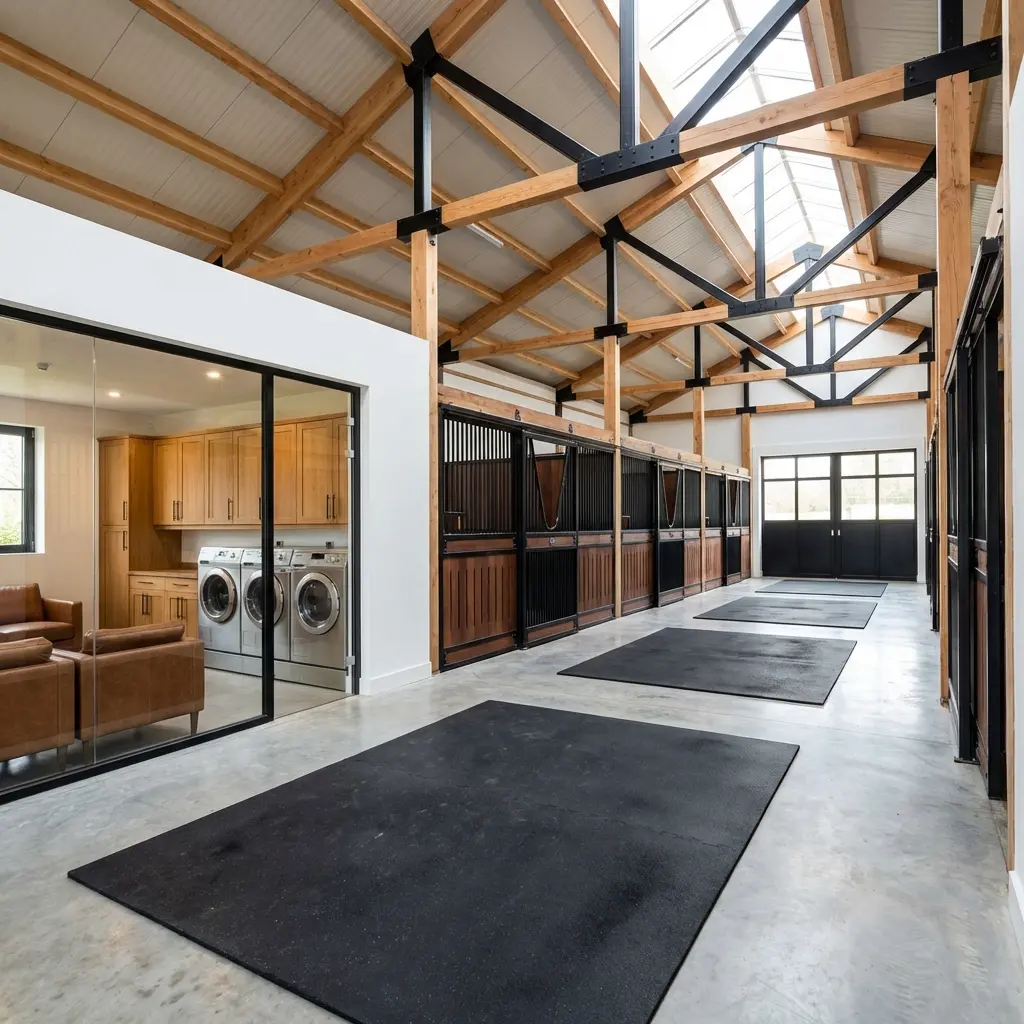
How to build and fit out a stable that will last: the right box sizes for height at withers, ceiling height, ventilation, light, safe materials and fire protection — in line with the requirements of Jordbruksverket, the Swedish Board of Agriculture.
The stable is the horse's home, and your workplace too. Get the dimensions right, keep the air moving and choose materials a horse cannot injure itself on, and you have a building that stays healthy to live in and safe to work in. This guide sets out what applies to box sizes, ceiling height, ventilation and safety — whether you are building from scratch or renovating.
How large a box must be is set by the horse's height at the withers, and is laid down in Jordbruksverket's regulations on the keeping of horses (SJVFS 2019:17). The table below gives the smallest sizes permitted for individual stabling in a loose box. The box must also always be laid out so the horse can turn, lie down, rest and get up again in a natural way.
| Height at withers (m) | Minimum box area | Shortest side |
|---|---|---|
| Under 0.85 | 3.0 m² | 1.50 m |
| 0.86–1.07 | 4.0 m² | 1.60 m |
| 1.08–1.30 | 5.0 m² | 1.90 m |
| 1.31–1.40 | 6.0 m² | 2.10 m |
| 1.41–1.48 | 7.0 m² | 2.20 m |
| 1.49–1.60 | 8.0 m² | 2.35 m |
| 1.61–1.70 | 9.0 m² | 2.50 m |
| 1.71–1.80 | 10.0 m² | 2.70 m |
| 1.81–1.90 | 11.0 m² | 2.80 m |
| Over 1.90 | 13.0 m² | 3.00 m |
Under Jordbruksverket rules, ceiling height must be at least 1.5 × the horse's height at the withers. It is measured from the floor (including any bedding) up to the lowest part of the roof structure. The rule does not apply to building details that sit directly above box or stall walls, but the height must never be so low that it makes looking after the horse difficult.
| Height at withers | Minimum clear ceiling height (1.5 ×) |
|---|---|
| 1.50 m | 2.25 m |
| 1.60 m | 2.40 m |
| 1.70 m | 2.55 m |
| 1.80 m | 2.70 m |
A horse's airways depend on decent air. The stable needs ventilation that actually works: moisture, ammonia and dust have to leave, without a cold draught settling at box height. Daylight matters too — for the horse's body clock and for its health.
Choose materials that are tough, smooth and free of sharp edges. Box walls have to take a kick, and every fitting should be horse-safe. Electrics, lighting and cables belong behind protection, and they should be installed by a qualified electrician.
Fire is among the greatest risks in a stable. Plan for a swift evacuation, materials that will not feed a blaze, and routines that lower the chance of one starting. Fire protection that has been thought through can save lives.
The smallest area is calculated from the horse's height at the withers, as set out in Jordbruksverket's regulations (SJVFS 2019:17). For individual stabling, a horse of 1.08–1.30 m needs 5.0 m² (shortest side 1.90 m); 1.31–1.40 m needs 6.0 m² (2.10 m); 1.49–1.60 m needs 8.0 m² (2.35 m); and 1.61–1.70 m needs 9.0 m² (2.50 m). The box must always be large enough for the horse to turn, lie down and get up freely — and these are minima, so it is well worth building more generously.
According to Jordbruksverket, the clear ceiling height must be at least 1.5 × the horse's height at the withers, measured from the floor to the lowest part of the roof structure. A horse of 1.60 m therefore needs at least 2.40 m, and 1.70 m needs 2.55 m. Remember that as the bedding builds up, the floor rises with it, so plan with a margin.
Aim for effective ventilation with supply and extract air, carrying away moisture, ammonia and dust without a cold draught at box height. Pair that with dust-free bedding and feed, and with plenty of daylight. A decent stable climate is essential for the horse's airways.
Clear, wide escape routes, a headcollar at every box, working fire detection and extinguishing equipment, and hay, straw and machinery stored in fire-separated spaces. Have a qualified electrician inspect the installations regularly.