
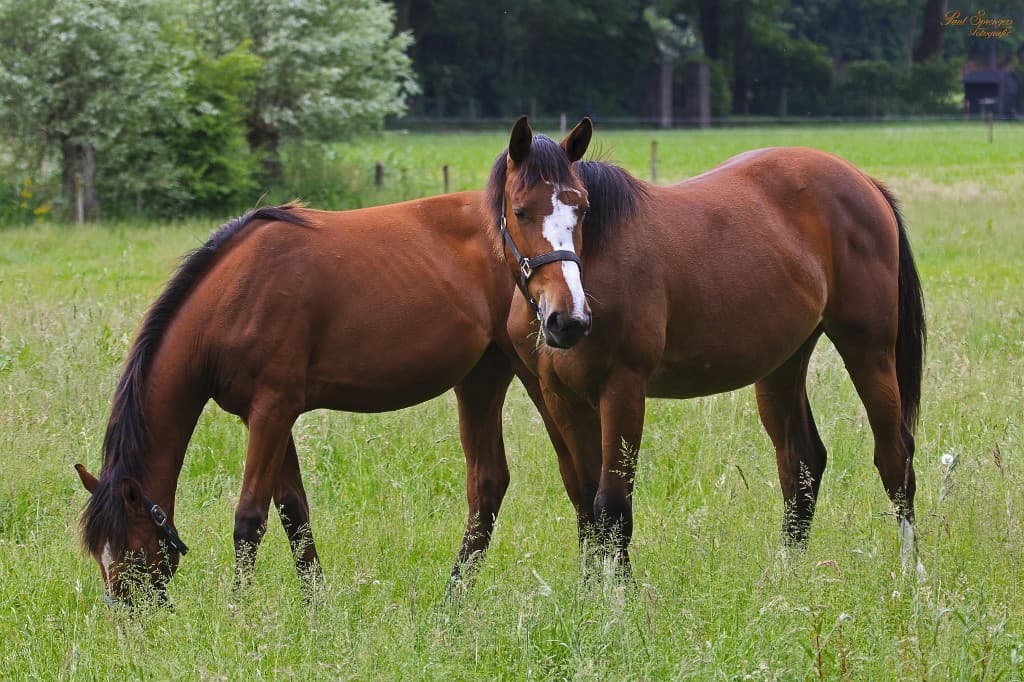
Behaviour can be hard to read; the horse's body is often clearer.
Behaviour can be hard to read; the horse's body is often clearer. Feed, environment and physical health are also the part of horse welfare where quantified research is most abundant.
The horse evolved to graze fibre-rich grass for large parts of the day. Free-living horses spend around 60 per cent of their time eating, compared with competition horses in individual boxes, which spend only about 15 per cent of their time eating – even though total eating time is often compressed into four or five hours instead of being spread through the day. Modern horse-keeping, with limited grazing and concentrate-based diets, therefore sets up a basic conflict with the horse's biology.
The research consistently shows high figures. Studies of competition horses in active work have found gastric ulcers in 80 to 90 per cent of Thoroughbreds in racing and in 60 per cent of show horses. The problem remains even in populations with better feeding: a study of Icelandic horses found gastroscopically significant ulcers (grade ≥2/4) in around 27 per cent, even though the horses were kept at yards with low starch and sugar in the ration.
The link with how horses are fed is well documented. A study at a sport-horse yard found that regular access to conserved forage three or more times a day markedly improved the odds of fewer ulcers in the non-glandular (squamous) gastric mucosa. The same researchers noted that pasture access alone, without extra forage, does not automatically mean a low incidence of ulcers – regular forage was the more important factor.
Ulcers in the glandular part of the stomach (equine glandular gastric disease, EGGD) are at least as common, but less well understood. Research puts the prevalence of this type of ulcer at anywhere from around 15 per cent to over 60 per cent, with 50–60 per cent reported in both leisure and competition horses, and without a clear link to the risk factors otherwise associated with ulcers in the non-glandular mucosa.
Colic remains one of the most serious health problems. Research has identified several risk factors that work together: parasite burden, certain types of feed, a recent change of diet, box stabling, lack of access to pasture and water, increased training, and transport. Crib-biting horses are at extra risk: research shows that crib-biting/windsucking behaviour has been identified as a risk factor for specific types of colic, including simple colonic obstruction and distension colic, and epiploic foramen entrapment (a hernia through the opening beside the spleen).
Chronic hoof problems are among the most common causes of reduced mobility in the horse, but because the animal rarely shows clear lameness until the problem is well advanced, regular, proactive hoof care is needed rather than treatment after the fact.
A recurring conclusion in veterinary research is that pain in horses has long been underdiagnosed, partly because of the species' ability to hide discomfort – which led to the development of standardised pain scales such as the Horse Grimace Scale (see the separate feature on the horse's mental health and behaviour for more on this).
At Hästannons we believe welfare and responsible ownership belong together – whether you buy, sell, breed or ride. Read on in the series, and in our practical guides.
Research shows high levels in competition populations (up to 80–90 per cent in some groups), but also in leisure horses with relatively good feeding.
Regular access to forage several times a day is one of the most important factors – pasture alone is not always enough.
They include parasites, changes of feed, box stabling, limited grazing, transport, increased training, and stereotypies such as crib-biting.